

Hardboiled detective fiction emerged not in 1900, but in the gritty pulp magazines of the 1920s and 1930s, when writers like Dashiell Hammett and Carroll John Daly stripped away the genteel puzzle-solving of Victorian mysteries and replaced it with violence, moral ambiguity, and cynical private eyes navigating corrupt American cities. If you’re searching for “Volume 1900,” you’re likely looking at a collected anthology or retrospective series examining the genre’s roots, because the hardboiled style as we know it simply didn’t exist at the turn of the twentieth century. What readers enjoyed in 1900 were locked-room mysteries and brilliant amateur sleuths in the tradition of Sherlock Holmes, not the whiskey-soaked, fist-throwing gumshoes that would define hardboiled fiction a generation later.
The confusion is understandable. Crime fiction certainly existed in 1900, but it occupied a completely different world. Arthur Conan Doyle’s cerebral detective still reigned supreme, and the mean streets of pulp magazines lay decades in the future. The hardboiled revolution required World War I’s disillusionment, Prohibition’s lawlessness, and the economic desperation of the Great Depression to crystalize into the genre we recognize today.
Understanding this timeline matters because hardboiled detective fiction represents a seismic shift in how crime stories were told. The genre rejected intellectual puzzle-solving for visceral action, swapped country manors for urban decay, and traded omniscient narrators for first-person voices dripping with world-weary sarcasm. Canadian writers would eventually join this tradition, adding their own frost-bitten noir sensibility to the form, but first we need to understand where hardboiled fiction actually began and why its late-1920s birth changed crime writing forever.
Before the Hardboiled: The Detective Fiction Landscape of 1900
Picture the detective fiction of 1900, and you’re stepping into a world of genteel parlor mysteries where brilliant minds solve impossible crimes through sheer deductive reasoning. Sherlock Holmes ruled this landscape, having captivated readers since 1887 with his extraordinary intellect and scientific method. These cerebral puzzle-solvers operated in a comfortable universe where good and evil were clearly defined, the police were generally competent (if occasionally slow), and justice reliably prevailed before the final page.
Arthur Conan Doyle’s Holmes set the template that dozens of imitators followed. Detection was an intellectual exercise, a battle of wits between genius detective and cunning criminal. Violence happened offstage. Blood rarely appeared on the page. The detective himself remained untouched by the sordid details of crime, observing from a position of social and moral superiority. These were stories designed to reassure Victorian and Edwardian readers that reason could triumph over chaos.
But the world was changing faster than the fiction reflected it.
American cities were exploding with immigration and industrialization. New York’s population had doubled between 1890 and 1910. Chicago grew from a prairie town to a sprawling metropolis in a generation. With that growth came overcrowded tenements, labor violence, political corruption, and organized criminal enterprises that made Victorian villains look quaint. Real detectives weren’t aristocratic consulting geniuses, they were Pinkertons hired to break strikes, corrupt cops on the take, or weary private investigators chasing insurance fraud through dangerous neighborhoods.
Readers who lived these realities started finding the drawing-room mystery inadequate. They’d seen too much. The growing working and middle classes wanted fiction that acknowledged the world they inhabited, where crime wasn’t a clever puzzle but a daily threat, where the police couldn’t always be trusted, and where justice was messy, violent, and uncertain.
The stage was set for fictional detectives who got their hands dirty, who understood that solving the crime was only half the battle, and who knew the mean streets intimately because they walked them every day. The hardboiled detective was waiting in the wings, ready to speak for a grittier, more cynical age.
The Pulp Magazine Revolution: Hardboiled Fiction’s Breeding Ground
The explosion of pulp magazines in the early 1900s gave hardboiled detective fiction the oxygen it needed to breathe. These cheaply produced periodicals, printed on rough, untrimmed paper that gave them their name, operated on razor-thin profit margins that demanded one thing above all else: stories that grabbed readers by the throat and didn’t let go. No leisurely puzzle-solving in drawing rooms here. Publishers needed fast-paced, action-packed tales that kept working-class readers coming back for their weekly or monthly fix.
The economics were brutal and beautiful. Pulps paid writers a penny or two per word, sometimes less, which meant authors had to crank out thousands of words to make rent. This financial pressure created a literary pressure cooker. Writers learned to cut every unnecessary word, to hit hard and move fast. They couldn’t afford the genteel pacing of Victorian mysteries. The relationship between pulp magazines and detective fiction transformed the genre from cerebral exercise to visceral experience.
Early crime and adventure pulps like Argosy and Detective Story Magazine tested the waters in the 1910s, but everything changed when Black Mask founded in 1920 under H.L. Mencken and George Jean Nathan. Though originally conceived as a general fiction magazine to fund their highbrow ventures, Black Mask stumbled onto gold when it pivoted to hard-edged crime fiction. Editor Joseph Shaw later refined this into a house style: tough, realistic, unsentimental detective stories that reflected actual American violence and corruption.
The “volume” concept referred to these serialized publications themselves, each issue was essentially a volume of short crime fiction, building a library of street-smart detection that readers devoured month after month. This format allowed writers to experiment, refine character types, and build readership for their tough-talking detectives in ways that traditional book publishing never could.

Defining Characteristics: What Makes a Detective ‘Hardboiled’
The Voice: First-Person Narration and Wise-Cracking Prose
The hardboiled detective needed to sound like he’d lived through what he was describing, not like some omniscient narrator floating above the action. That’s why first-person narration became the backbone of the genre. When Sam Spade or Philip Marlowe tells you what happened, you’re getting it filtered through their world-weary perspective, complete with their prejudices, blind spots, and hard-won wisdom.
This narrative choice put readers inside the detective’s head during the investigation. You experience the uncertainty, the false leads, the gut instincts that might be right or catastrophically wrong. The detective doesn’t know how the story ends when he’s living it, and neither do you. That immediacy created tension impossible to achieve when an all-knowing narrator tells you what happened after the fact.
But it was the voice itself that made hardboiled fiction sing. These detectives talked like real people, not Victorian gentlemen. Short, punchy sentences. Slang that came from actual streets. Metaphors that mixed poetry with violence: “She gave me a smile I could feel in my hip pocket.” The wise-cracks weren’t just funny, they were armor, a way of processing horror without falling apart.
That cynical humor distinguished hardboiled prose from everything that came before. When your detective can crack jokes while staring down a gun barrel, you’ve created a character readers want to follow through any danger. The voice promised honesty, even when the detective was lying to someone else. It was conversational, conspiratorial, like the detective was buying you a drink and telling you about the case that still kept him up nights.
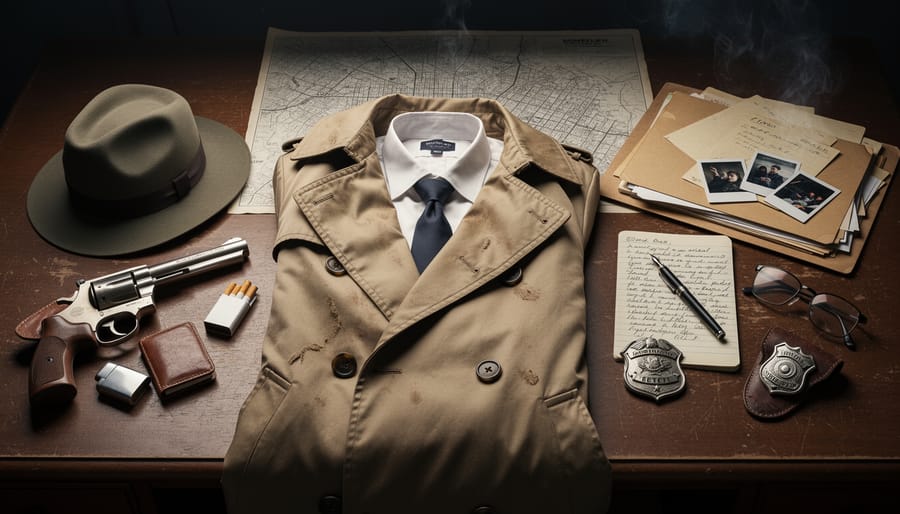
The Setting: Mean Streets and Corrupt Cities
The city in hardboiled detective fiction isn’t just backdrop, it’s a living, breathing presence that shapes and defines the stories. Early 1900s America was transforming rapidly, with millions pouring into urban centers for factory work and opportunity. These sprawling metropolises became pressure cookers of humanity: tenements stuffed with immigrants, speakeasies hidden behind legitimate storefronts, cops on the take, and politicians cutting deals with gangsters.
Hardboiled writers seized on this reality. Their fictional cities pulsed with electric lights and jazz clubs on one street, while the next block reeked of garbage and desperation. The detective navigates both worlds, equally at home in a Park Avenue penthouse and a Bowery flophouse. This duality made the urban setting more than scenery, it became the moral landscape of the genre itself.
Unlike the country manors and quaint villages of traditional detective fiction, hardboiled cities offered no refuge from corruption. City hall, the police station, even churches, all could harbor vice. The streets themselves felt threatening: dark alleys where anything might happen, rain-slicked pavement reflecting neon signs advertising cheap thrills and cheaper lives.
This urban authenticity resonated because readers lived it. They knew the gap between the city’s promise and its reality. When a hardboiled detective walked those mean streets, readers recognized the territory. The city wasn’t just where crime happened, it was what made the crime inevitable, and what made the detective necessary.

Early Pioneers: Writers Who Shaped the Hardboiled Template
The hardboiled detective didn’t spring fully formed from the pages of Black Mask in the 1920s. The genre’s roots stretch back to writers working in the early 1900s who were already pushing against the genteel constraints of Victorian detective fiction, even if they didn’t realize they were building something revolutionary. These pioneers experimented with grittier realism, morally ambiguous protagonists, and street-level crime that would become the foundation for Dashiell Hammett and Raymond Chandler’s later masterworks.
- Carroll John Daly
- Often credited with creating the first true hardboiled detective in his 1922 story “The False Burton Combs,” Daly’s Race Williams character was a gun-toting private eye who operated by his own moral code. His work in early pulp magazines established many genre conventions.
- Susan Glaspell
- Her 1917 short story “A Jury of Her Peers” introduced psychological realism and moral ambiguity to crime fiction, questioning legal justice versus human understanding. Though not hardboiled in style, her work challenged the neat resolutions of traditional detective stories.
- Frederick Irving Anderson
- Writing for magazines in the 1910s, Anderson created Deputy Parr, a detective who used underworld connections and operated in morally grey areas. His stories featured the cynical tone and corrupt urban settings that would define hardboiled fiction.
- Melville Davisson Post
- His Uncle Abner stories (starting 1911) blended frontier justice with detective work, creating a protagonist who enforced his own harsh moral code. Post’s influence on the hardboiled tradition lies in his rejection of law enforcement procedurals in favor of personal honor.
What united these early writers was their willingness to show crime as messy, justice as imperfect, and detectives as flawed human beings rather than infallible reasoning machines. They wrote for audiences living through rapid industrialization, urban crowding, and the breakdown of Victorian social certainties. Their fictional investigators reflected this new reality, operating in worlds where the police were often corrupt, the wealthy were frequently guilty, and solving the case didn’t always mean justice was served.
These proto-hardboiled stories appeared mostly in general fiction magazines and regional publications, not yet gathered under the hardboiled banner. But they were experimenting with the ingredients: first-person narration, action over deduction, working-class protagonists, and endings that left moral questions unresolved. When Hammett began writing in the 1920s, he was building on a foundation these earlier writers had already laid, refining their innovations into the hardboiled template we recognize today.

Fictional Hardboiled Detectives Who Became Icons
The fictional hardboiled detectives who walked off magazine pages and into cultural immortality didn’t arrive all at once. They came in waves through the 1920s and 1930s, each one refining what readers wanted from their crime solvers, characters who could take a punch, crack wise, and navigate moral gray zones without losing their compass.
Dashiell Hammett’s Continental Op, appearing in Black Mask starting in 1923, was the prototype. Short, fat, middle-aged, and nameless throughout dozens of stories, he worked for the Continental Detective Agency and did the job without pretense or poetry. When he investigated in *Red Harvest* (1929), he didn’t solve a puzzle, he orchestrated a gang war that left bodies stacked like cordwood. The Op demonstrated that hardboiled detective fiction could be brutal, pragmatic, and utterly unsentimental about violence or justice.
Sam Spade, also Hammett’s creation, appeared in *The Maltese Falcon* (1930) and became the face of the genre for generations. Spade was everything readers craved: tough enough to take beatings from cops and criminals alike, smart enough to play both sides, and principled in a way that had nothing to do with the law. When he sent the woman he loved to prison because “when a man’s partner is killed, he’s supposed to do something about it,” he defined the hardboiled code, personal honor over personal happiness.
Raymond Chandler’s Philip Marlowe raised the stakes by adding poetry to the violence. Debuting in *The Big Sleep* (1939), Marlowe was educated, literary, and capable of describing a blonde as having “hair the pale gold of a split aspen” one moment, then getting coshed unconscious the next. He brought introspection to the archetype, a detective who understood he was tilting at windmills in a corrupt Los Angeles but kept tilting anyway. Marlowe proved fictional hardboiled detectives could be both tough and thoughtful.
Race Williams, created by Carroll John Daly for Black Mask in 1923, often gets overlooked despite being arguably the first true hardboiled detective in print. Williams shot first and quipped later, blazing through stories with a .44 in each hand and minimal patience for legal niceties. He was crude compared to Hammett’s sophistication, but he established the template: a lone operator working by his own rules in a lawless landscape.
These detectives became icons because they spoke to something readers recognized, the sense that modern cities were corrupt from the mayor’s office to the gutter, and the only people you could trust were those who admitted they couldn’t be bought. They’re still being rewritten, reimagined, and imitated today because that cynical idealism never goes out of style.
Canadian Connections: Our Own Hardboiled Tradition
Canada’s hardboiled detective tradition didn’t emerge from the pulp magazines of the early 1900s, it took root later, shaped by our distinct urban landscapes and cultural sensibilities. Yet Canadian writers have created their own compelling takes on the genre, proving that cynical private eyes and moral ambiguity aren’t exclusively American exports.
Toronto’s Howard Engel pioneered Canadian hardboiled fiction with his Benny Cooperman series, launching in 1980 with “The Suicide Murders.” Cooperman, a Jewish private investigator working in the fictional Ontario town of Grantham, brought a particularly Canadian flavor to the archetype, self-deprecating, thoughtful, and navigating a society where violence simmers beneath a polite surface rather than exploding on every street corner.
Ted Wood’s Reid Bennett mysteries took the hardboiled detective north to Muskoka cottage country, where an ex-Toronto cop turned small-town police chief dealt with crimes that shattered rural Canadian tranquility. The novels demonstrated how the genre’s core elements, a principled investigator confronting corruption, could thrive outside major cities.
Montreal provided the perfect backdrop for hardboiled fiction’s moral complexity, with its linguistic tensions and organized crime history. Peter Kirby’s Luc Vanier series captures this brilliantly, presenting a detective who operates in both English and French while navigating the city’s sharp class divisions and institutional failures.
More recently, authors like Linwood Barclay have brought contemporary Toronto into the hardboiled tradition, while maintaining the genre’s essential DNA: flawed protagonists, compromised institutions, and the gnawing sense that justice exists separate from law.
What sets Canadian hardboiled fiction apart isn’t just geography. Our detectives tend toward introspection over violence, operate in cities where multiculturalism shapes criminal enterprises, and wrestle with particularly Canadian concerns, Indigenous justice, bilingual complexities, and the tension between our self-image as peacekeepers and the violence lurking in our streets. We’ve taken the template established in that foundational period around 1900 and filtered it through our own national character.
The hardboiled detective fiction that took shape in the early 1900s wasn’t just a literary trend, it was a seismic shift in how we tell stories about crime, justice, and human nature. More than a century later, those cynical private eyes still matter because the world they inhabited hasn’t disappeared. Corrupt institutions, moral ambiguity, and the struggle to do right in a wrong world? Those aren’t relics of 1900. They’re Tuesday.
Turn on any prestige crime drama, crack open a modern noir novel, or watch a morally compromised detective navigate institutional failure on screen, and you’re seeing the DNA of hardboiled detective fiction. The genre shaped everything from True Detective to Bosch, from Dennis Lehane’s Boston to Louise Penny’s Three Pines. Those fictional hardboiled detectives, the Sam Spades and Philip Marlowes, established a template we can’t seem to quit because we still need characters who maintain a personal code when systems fail.
If you’re ready to explore this foundational period, start with Dashiell Hammett’s Red Harvest or The Maltese Falcon, then move to Raymond Chandler’s The Big Sleep. For contemporary takes, try Ian Rankin’s Rebus series or grab something by a Canadian master like John McFetridge. The mean streets are still out there, and the detectives walking them, flawed, stubborn, indispensable, remain our most honest guides through the darkness.